
TLDR
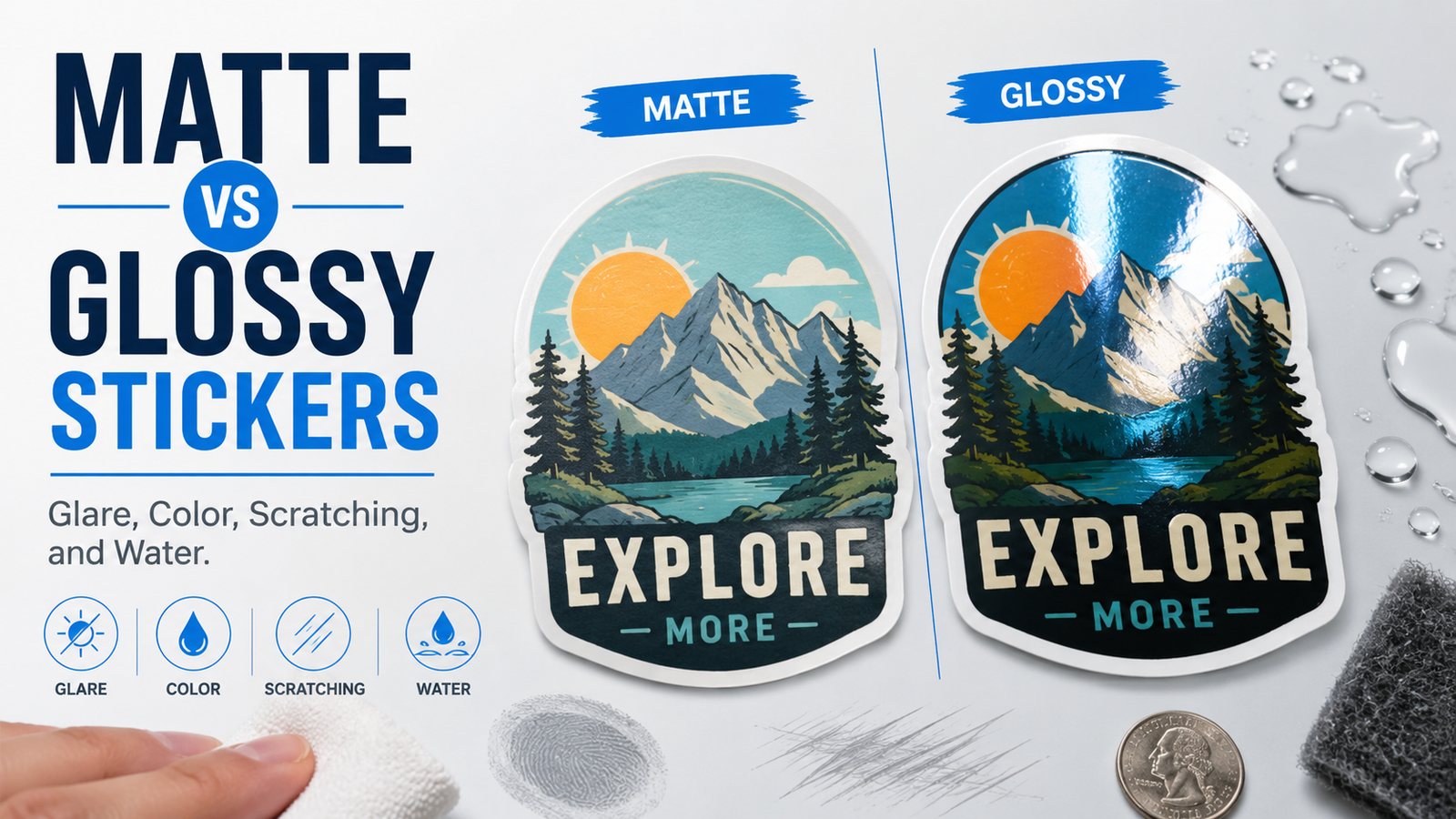
- Matte wins for glare, fingerprints, small-text readability, and easy product photography.
- Gloss wins for apparent color saturation, rich blacks, shine, and high-impact artwork.
- Matte often makes light scuffs less visible, but that does not automatically mean the laminate is physically more scratch-resistant.
- On comparable laminated vinyl, water resistance is primarily a construction issue rather than a matte-vs-gloss issue.
- If you’re choosing a finish for packaging or detailed labels, I lean matte. For colorful merch, logos, character art, and promotional stickers, I lean gloss.
We’ve already covered the basic matte vs glossy stickers question on PrintReviewer.
This is the follow-up I actually wanted.
Instead of asking whether matte looks “premium” and gloss looks “vibrant,” I wanted to focus on what happens when you put the finishes under annoying real-world conditions: bright overhead light, fingerprints, photography, surface rubbing, and water.
Because a laminate is not something you only look at in a product configurator.
You touch it. Turn it. Photograph it. Put it on a bottle. Slide it into a bag. Leave it under fluorescent lights. Occasionally spill something on it because apparently that is what desks are for.
The differences between matte and glossy sticker laminate become much clearer once the sticker leaves the screen.
The Short Version of Our Matte vs Gloss Results
Here is the practical result.
| Test | Matte | Gloss | Winner |
|---|---|---|---|
| Direct-light glare | Low | High | Matte |
| Apparent color saturation | Softer | Stronger | Gloss |
| Rich-looking blacks | Softer | Deeper | Gloss |
| Small-text readability | More consistent across angles | Can be obscured by reflections | Matte |
| Fingerprint visibility | Lower | Higher | Matte |
| Visible light scuffs | Usually less noticeable | Often easier to see in reflections | Matte |
| Water resistance on comparable laminated vinyl | Strong | Strong | Tie |
| Easy product photography | Easier | Requires more light control | Matte |
| Reflective promotional look | Subdued | Strong | Gloss |
The key word in the water and abrasion comparisons is comparable.
You cannot compare a laminated matte vinyl sticker with a cheap unlaminated glossy paper sticker and conclude that matte is stronger.
Finish is only one layer of the product.
PrintReviewer’s existing guide makes the same distinction: material, ink, laminate, adhesive, and intended use matter more to durability than whether the surface happens to be shiny.
What We Mean by Matte and Glossy Laminate
Both finishes can be applied as protective laminate over printed sticker material.
A glossy sticker laminate has a smooth, reflective surface. Light bounces toward the viewer more directly, producing the familiar shiny sticker appearance.
A matte sticker laminate diffuses reflections. The sticker still reflects light because it remains a physical object and has not discovered invisibility, but the reflection spreads more broadly instead of appearing as a sharp highlight.
That surface difference is why so many other characteristics change.
Gloss can make colors look richer.
Matte can make text look clearer.
The printed image underneath may be very similar. What your eyes receive is different.
Commercial sticker companies likewise describe gloss as more reflective and saturated while matte produces less glare and a softer appearance.
Test 1: Glare
This one was not close.
Matte is much easier to view under direct lighting.
Put a glossy sticker beneath a strong overhead light and rotate it. At certain angles, the reflected light becomes the brightest thing you can see.
That is not always bad.
A little controlled shine can make a sticker look bright and polished. But if the sticker contains:
- Fine text
- Instructions
- Ingredients
- A QR code
- A URL
- Small contact information
then glare is competing with information.
Matte spreads that reflection and keeps more of the design visible as the angle changes.
This is why our existing PrintReviewer guidance already favors matte for small text and text-heavy product labels.
Matte wins the glare test
If the sticker’s job is to be read, matte has a real practical advantage.
If its job is to flash color from across a room, gloss may turn that same reflection into an asset.
Test 2: Color Saturation and Contrast
This one goes the other direction.
Gloss makes colorful artwork look punchier.
Bright reds, blues, greens, and dark backgrounds gain more apparent depth under a glossy surface. Black also tends to look deeper.
Matte reduces that reflective punch.
The colors do not suddenly become bad. In some artwork, the softer appearance is actually preferable. Illustration, earth tones, minimalist packaging, vintage graphics, and photography can all look very good without strong surface shine.
But if you put the same colorful design in front of someone and ask which one feels more saturated, gloss usually has the advantage.
Our previous PrintReviewer finish guide reached the same conclusion, and current printer guidance consistently describes glossy finishes as brighter or more saturated while matte produces a softer appearance.
Gloss wins color punch
That makes gloss particularly good for:
- Mascot stickers
- Anime and cartoon artwork
- Bright logos
- Sports graphics
- Band stickers
- Kids’ designs
- Food promos
- High-saturation photography
It is not more accurate simply because it appears richer.
It is more visually assertive.
Those are different things.
Test 3: Fingerprints and Handling
Gloss has a small but annoying problem.
It tells on you.
Touch a shiny dark sticker with slightly oily fingers and there is a decent chance you’ll see where you touched it once the light catches the surface.
Matte is more forgiving.
The lower-reflection surface makes fingerprints and smudges less obvious, a characteristic also reflected in commercial finish guidance.
That matters more on some products than others.
Nobody cares much about a fingerprint on a sticker slapped onto the side of a toolbox.
It matters more on:
- Cosmetic packaging
- Candle labels
- Boutique product boxes
- Coffee bags
- Electronics
- Presentation folders
- Retail packaging photographed for ecommerce
If customers repeatedly handle the surface, matte tends to stay looking visually cleaner.
Matte wins fingerprints
This is one reason I generally prefer matte for restrained packaging and branding.
It requires less cooperation from the lighting, the photographer, and the person who picked it up five minutes ago.
Test 4: Scratching and Abrasion
This category needs a distinction people often miss.
There are two separate questions:
- Which sticker actually resists scratching better?
- Which sticker makes small scratches easier to see?
Those are not the same thing.
A matte finish can hide fine surface marks because the entire surface already scatters light.
A glossy finish behaves almost like a tiny mirror. Put a hairline scuff through that smooth reflection and the scratch interrupts it, sometimes making the damage easier to see.
That does not prove the matte laminate is chemically or physically tougher.
Sticker durability depends on the laminate formulation, thickness, vinyl, inks, adhesive, exposure, and manufacturing process. PrintReviewer’s methodology specifically separates material and finish evaluation from broad claims that one treatment is universally superior.
Commercial laminate guidance also tends to describe matte and gloss versions built on the same underlying vinyl as having broadly similar protective roles even though visible scratches and fingerprints may present differently.
Matte wins at hiding minor surface wear
But I would call actual scratch resistance a construction question, not a finish-only question.
If abrasion matters, ask about the laminate itself.
Do not simply tick “gloss” and assume you have purchased armor.
Test 5: Water
This is where a lot of sticker advice gets sloppy.
Gloss does not automatically mean waterproof.
And matte does not automatically mean less waterproof.
A glossy paper sticker may fail almost immediately in sustained moisture.
A properly laminated matte vinyl sticker may hold up very well.
Both matte and gloss can be used on waterproof or weather-resistant vinyl constructions. PrintReviewer’s current guidance explicitly warns readers not to choose an outdoor sticker based on surface finish alone.
So when the underlying sticker construction is comparable, I would treat this category as a tie.
Water test: tie
For a water bottle, cooler, car window, equipment case, or outdoor application, ask:
- Is the face stock vinyl or another water-resistant film?
- Is the print laminated?
- What adhesive is being used?
- Is the finished product rated for outdoor use?
- Are the edges likely to see prolonged immersion?
- Is the application surface appropriate?
Those answers tell you far more than matte versus gloss.
Test 6: Photographing the Stickers
This is the category people often discover after ordering.
Glossy stickers can look fantastic in a photograph.
They can also be a pain to photograph.
You have a small reflective surface, and the job of product photography suddenly becomes hiding everything that is reflected in it.
Move the light.
Move the camera.
Change the sticker angle.
Move the light again.
Wonder why you can see a rectangular window in the black part of your logo.
Matte is much easier.
Because the reflections are diffused, you can usually position the sticker in a broader range of lighting setups without creating a bright white hotspot across the artwork.
Matte wins for easy ecommerce photography
For:
- Etsy listings
- Product packaging
- Catalog photos
- Amazon listings
- Small-business social media
- Flat lays
I generally prefer matte if photography is a major part of the product’s job.
Gloss is still viable. You simply need more control over lighting.
And sometimes that reflection is exactly what you want. A controlled highlight can communicate that the sticker is glossy in a way a perfectly flat photograph cannot.
Which Finish Handles Fine Text Better?
Matte.
Not because a matte printer magically has higher resolution.
Because you can see the text from more angles without a reflection sitting on top of it.
That matters most with:
- Small ingredient text
- Product instructions
- Website addresses
- Social handles
- QR codes
- Safety information
- Serial or equipment labels
But finish cannot rescue bad typography.
Tiny light gray lettering on a slightly lighter gray background will remain a bad idea in matte.
It will simply be a non-reflective bad idea.
What About QR Codes?
I lean matte when the QR code itself is the important part of the sticker.
QR codes rely on clean contrast, intact modules, and a clear quiet zone. DENSO WAVE specifies a four-module clear margin around standard QR codes and warns that distortion or visual interference can reduce readability.
Gloss does not inherently prevent a QR code from scanning.
A well-printed glossy QR sticker may scan perfectly.
But strong glare can create an unfavorable reading angle. Matte simply removes one variable from the problem.
For a promotional logo sticker with a secondary QR code, either finish may be fine.
For a tiny QR inventory label that absolutely has to scan, I would rather optimize for readability than shine.
Matte vs Gloss for Product Labels
For product labels, I usually start with matte when the brand relies on:
- Text
- Minimalist packaging
- Natural colors
- White space
- Fine illustration
- Premium photography
- Subtle typography
I would start with gloss when the product relies on:
- Bright shelf color
- Candy-style branding
- Saturated photography
- Cartoon graphics
- Large logos
- Sports or energy branding
- A deliberately shiny retail appearance
There is no rule saying matte is “premium” and gloss is “cheap.”
That is lazy shorthand.
Both can look excellent.
The useful question is what the finish does to your particular artwork under the lighting where people will see it.
Matte vs Gloss for Artist Stickers and Merch
For merch, I give gloss more room.
If someone is buying a colorful character sticker, they often want the image itself to have impact.
Gloss works particularly well for:
- Saturated digital illustration
- Fantasy art
- Cartoon characters
- Bright vector graphics
- Dark-background artwork
- Logo stickers
Matte works well for:
- Pencil-style illustration
- Watercolor-inspired work
- Vintage graphics
- Muted palettes
- Line art
- Editorial-style photography
And there is no substitute for ordering both when the artwork matters.
A screen cannot reproduce reflected light.
A digital proof can tell you if your spelling and cutline are correct. It cannot hand you a laminate and rotate it beneath a lamp.
Does Gloss Last Longer Than Matte?
Not as a general rule.
This is probably the most important conclusion from the comparison.
Finish is not durability.
A good laminated sticker is a layered product.
The relevant variables include:
- Face material
- Ink
- Laminate
- Adhesive
- Print process
- Application surface
- UV exposure
- Moisture
- Abrasion
- Temperature
Matte and glossy variants made from comparable vinyl and protective laminates can have similar practical durability.
Pick gloss because you want gloss.
Do not pick it because shine looks vaguely waterproof.
Our Recommendation
After comparing the practical differences, I would choose matte for readability and controlled presentation and gloss for color impact.
Matte wins when I care most about:
- Glare
- Small text
- Fingerprints
- Easy photography
- Subtle packaging
- Fine-detail readability
Gloss wins when I care most about:
- Saturation
- Deep-looking blacks
- Shine
- Bright promotional art
- Colorful merch
- Visual impact
Water resistance is effectively a tie when the construction is comparable.
Scratch resistance needs more context, although matte often hides small surface marks better.
That is a much more useful answer than saying one finish is universally better.
The laminate is not the design.
It is the lens people see the design through.
FAQs
Are matte or glossy stickers more waterproof?
Neither finish is automatically more waterproof. Water resistance depends on the sticker material, laminate, ink system, adhesive, and construction. Both matte and gloss laminated vinyl stickers can be suitable for wet or outdoor use.
Which sticker finish scratches less?
You cannot determine true scratch resistance from surface sheen alone. Matte often makes light surface scuffs less visible, while glossy surfaces can make scratches stand out because they interrupt the reflection.
Do matte stickers look less colorful?
Matte generally produces a softer appearance. Gloss tends to make colors and dark tones look more saturated because of its reflective surface.
Is matte or gloss better for QR code stickers?
Either can scan if the QR code is designed and printed correctly. Matte has the practical advantage of reducing glare. Regardless of finish, maintain good contrast, enough module size, and the required quiet zone.
Is matte or gloss better for photos?
Gloss generally produces stronger apparent color and contrast. Matte can be better when you want less glare or a softer editorial look.
Which finish is easier to photograph?
Matte is usually easier because you have fewer strong reflections to control. Gloss can look excellent but requires more deliberate lighting.
References
- PrintReviewer, Matte vs Gloss Stickers: Which Finish Should You Choose?
- PrintReviewer, Review Methodology.
- Stickers.com, matte vs gloss lamination guidance.
- PrintRunner, Matte Stickers vs. Gloss Stickers.
- DENSO WAVE, QR Code printing guidance.
Intent Sentence
This post helps sticker buyers choose between matte and glossy sticker laminate by comparing glare, color, fingerprints, visible scratching, water resistance, readability, and photography, so they can select the finish that actually works for their design and use case.