
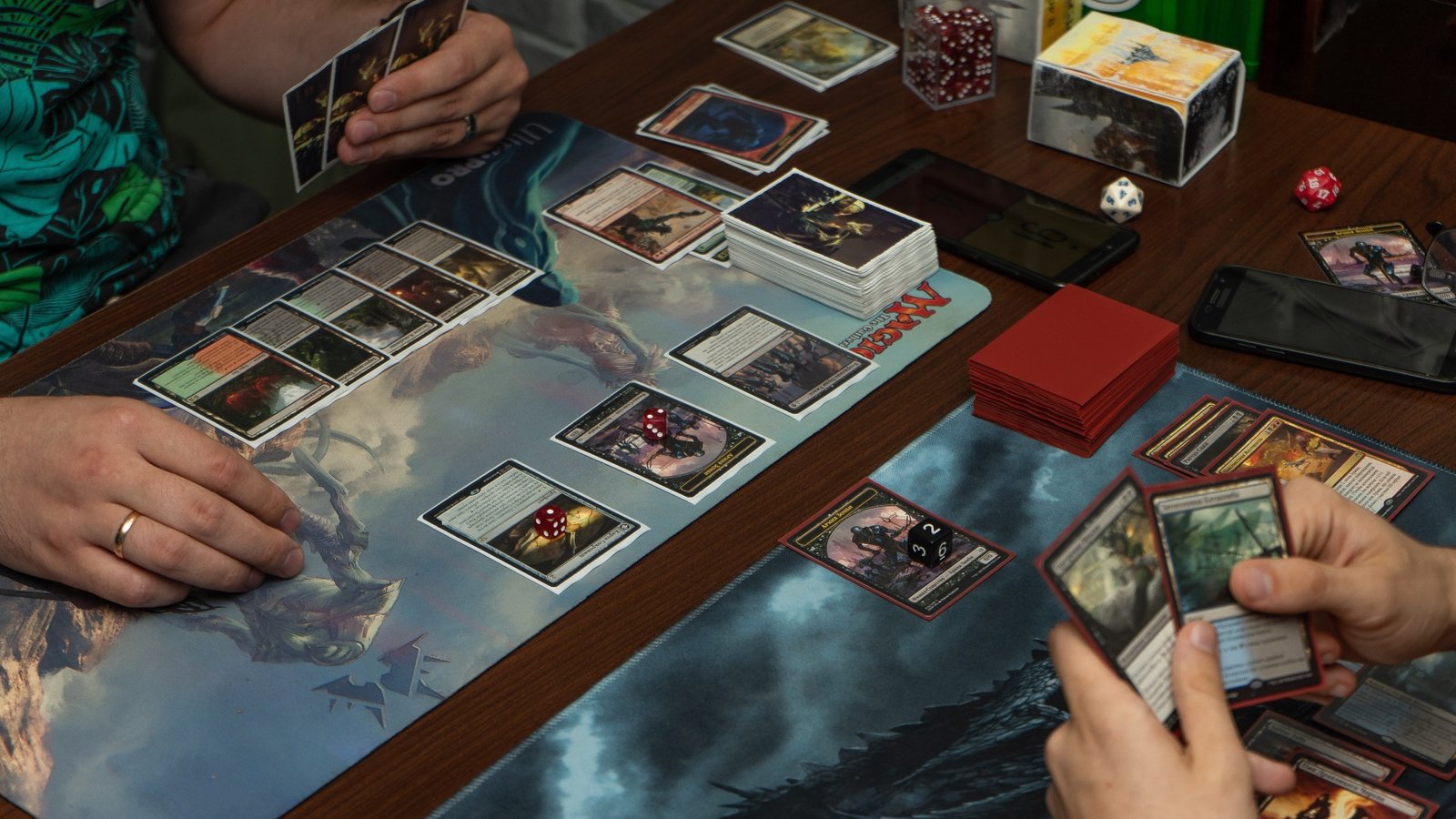
There’s a dumb little truth in Magic: punctuation wins games.
If you can spot a colon, you’re already halfway to understanding how a card works. If you can spot “when/whenever/at,” you’re even closer. And if you know which abilities don’t use the stack, you’ll stop wasting removal “in response” to things you can’t respond to anyway.
This guide is the clean, beginner-friendly version of ability types in MTG: activated, triggered, mana, and static abilities—plus the most common traps that make them feel confusing.
What counts as an “ability” in MTG?
An ability is basically “text that changes the game” that isn’t a spell resolving. Most abilities live on permanents (creatures, artifacts, enchantments, lands, planeswalkers). But some work from other zones too (like cycling from your hand or flashback-style abilities from your graveyard).
The important part for gameplay is this:
- Some abilities happen because you choose to use them.
- Some happen automatically when something occurs.
- Some don’t use the stack at all.
- Some are just… true, all the time.
That’s the whole map.
Activated abilities: Cost : Effect (the colon is the giveaway)
Activated abilities are the ones you choose to turn on. They’re written like:
[Cost]: [Effect]
Examples:
- “{T}: Add {G}.”
- “{2}, {T}: Draw a card.”
- “Sacrifice a creature: This gets +2/+2 until end of turn.”
- “Pay 1 life: Scry 1.”
The three things to remember about activated abilities
1) You pay costs up front.
Everything before the colon is the cost. You don’t get the effect unless you pay the cost.
2) You can’t respond to paying costs.
This is the classic misunderstanding. If the cost is “sacrifice a creature,” that creature is already gone before anyone can respond. You can respond to the ability on the stack, but you can’t interrupt the payment.
3) Most activated abilities use the stack.
After you activate it (and pay the cost), the ability goes on the stack. Players can respond with instants or their own abilities.
Timing: when can you activate?
Usually: any time you have priority (which often means “at instant speed”). But some activated abilities include restrictions like:
- “Activate only as a sorcery” (main phase, stack empty, you have priority)
- “Activate only once each turn”
- “Activate only during combat”
Summoning sickness matters (sometimes)
If the cost includes {T} (tap) or {Q} (untap), and it’s a creature, summoning sickness applies. If you haven’t controlled it since the start of your most recent turn, you can’t activate those tap/untap-cost abilities unless it has haste.
Triggered abilities: When / Whenever / At (automatic, whether you like it or not)
Triggered abilities don’t ask permission. They happen because the trigger event happened.
They’re written like:
When / Whenever / At [event], [effect].
Examples:
- “When this creature enters the battlefield, draw a card.”
- “Whenever you cast a noncreature spell, this gets +1/+1 until end of turn.”
- “At the beginning of your upkeep, lose 1 life.”
What actually happens when something triggers?
The game notices the trigger, and then the triggered ability gets put on the stack the next time a player would get priority. Then players can respond like normal.
Key differences vs activated abilities
You don’t choose whether it triggers.
(You might choose modes or targets when it goes on the stack, but the trigger itself happens automatically.)
There’s no colon.
If you don’t see a colon and you do see “when/whenever/at,” you’re in triggered territory.
A beginner-friendly “combo” example of why timing matters
Triggered abilities are why stuff like “enters-the-battlefield” effects can be interacted with. If your opponent plays a creature with a nasty ETB trigger, you can sometimes respond to the trigger even if removing the creature won’t undo the ability.
That leads to an important rule-feel lesson:
Removing the source doesn’t usually stop the triggered ability.
Once it’s on the stack, it exists independently.
Delayed triggered abilities (the “later” triggers)
A lot of cards create triggers that happen later, like:
- “At the beginning of the next end step…”
- “When this creature dies…”
- “Until end of turn…”
The “delayed” part just means the game sets up a trigger now that will fire later when its condition is met.
Mana abilities: the “no stack” exception
Mana abilities are where Magic stops being polite.
A mana ability is an activated or triggered ability that produces mana and meets specific rules. The payoff is huge:
Mana abilities do not use the stack
That means:
- They resolve immediately.
- Players cannot respond to them.
So you can’t say “in response to you tapping that land…” the way you can respond to a normal activated ability.
What counts as a mana ability?
Activated mana ability (common):
- It could add mana
- It has no targets
- It is not a planeswalker loyalty ability
Most lands and mana dorks are in this bucket.
Triggered mana ability (less common, but real):
Triggered abilities can also be mana abilities if they trigger from mana being added or from activating a mana ability, have no targets, and could add mana.
A classic example style is:
- “Whenever a player taps a land for mana, that player adds one mana…”
Even though it starts with “whenever” (triggered), it can still be a mana ability, which means it resolves immediately and can’t be responded to.
Why this matters in real games
Mana abilities are why you can float mana while doing other things, and why “counter target activated ability” doesn’t stop a land from tapping for mana. There’s nothing to counter on the stack.
Also important: not everything that makes mana is a mana ability.
Some effects add mana but still use the stack because they don’t meet the definition. Planeswalker loyalty abilities that add mana are a common example: they’re activated, they make mana, but they’re still loyalty abilities—so they use the stack and can be responded to.
Static abilities: always on (and usually not on the stack)
Static abilities are the ones that don’t “happen” once. They just are.
Examples:
- “Creatures you control get +1/+1.”
- “Noncreature spells cost {1} more to cast.”
- Flying, deathtouch, vigilance, menace (most keyword abilities like these are static)
Static abilities don’t go on the stack. They’re continuous rules effects that apply while the card (or object) is in the right zone.
If you remove the permanent, the effect stops—because the source is gone, not because you “responded” to anything.
Static abilities often create continuous effects
Think of them like an invisible aura stapled to the battlefield:
- Thalia taxes spells as long as she’s around.
- An anthem effect boosts your team as long as it’s around.
Some static abilities also create replacement effects (more on that next), which is where a lot of confusion lives.
The common traps: replacement effects, keyword abilities, and special actions
If you’ve ever looked at a card and thought, “okay, but what type of ability is this?” it’s usually one of these.
Trap #1: Replacement effects aren’t triggered abilities
Replacement effects often use words like:
- if
- instead
- as
- would
Example pattern:
- “If a creature would die, exile it instead.”
That’s not a “when it dies” trigger. It changes what “dying” means in the first place. No stack. No responding to it like a trigger. You can respond to the spell/ability that created the replacement effect, but once the replacement effect exists, it applies automatically.
Trap #2: Keyword abilities can hide what they are
Some abilities are activated even if you don’t see the colon in the reminder text (or the reminder text isn’t printed at all).
Examples:
- Equip (activated ability, usually sorcery speed)
- Crew (activated ability)
- Cycling (activated ability from your hand)
- Channel (activated ability from your hand)
Rule of thumb: if it’s a keyword that has a cost to use, it’s often an activated ability—even if the card frame doesn’t spell it out fully.
Trap #3: Some “cost-paying” things aren’t activated abilities
Paying a cost doesn’t automatically make something “activated.”
You pay costs when:
- casting spells
- activating abilities
- resolving some effects (“you may pay… if you do…”)
If a triggered ability says “you may pay {2}. If you do, draw a card,” that’s still a triggered ability. You’re just making a choice during resolution.
Trap #4: Special actions (they aren’t abilities, and they don’t use the stack)
Some game actions don’t use the stack at all:
- playing a land
- turning a face-down creature face up via morph (the turning face up is a special action)
These aren’t activated abilities, even though they may involve paying something. They’re their own category in the rules.
Quick cheat sheet: how to identify each ability type fast
Use this like a card-text speedrun.
Activated ability
- Has a colon
- You choose when to use it
- “Cost : Effect”
Triggered ability
- Starts with When / Whenever / At
- Happens automatically when the condition is met
- Uses the stack (most of the time)
Mana ability
- Makes mana and meets the mana-ability rules
- Does not use the stack
- Usually has no target
- Can be activated or triggered
Static ability
- No colon, no “when/whenever/at”
- Just true while the card is around
- Usually no stack involved
FAQs
Do activated abilities always use the stack?
Most do, but mana abilities are the big exception. They resolve immediately.
Can I respond to my opponent tapping a land?
No. Tapping a land for mana is a mana ability, so there’s nothing on the stack to respond to.
If I kill the creature, does its triggered ability stop?
Usually no. Once the triggered ability is on the stack, removing the source doesn’t erase it.
If a triggered ability says “you may pay,” is that an activated ability?
No. It’s still triggered. That’s just a choice you make during resolution.
Are planeswalker loyalty abilities activated abilities?
Yes, they’re activated abilities. But they’re also loyalty abilities, which comes with special timing rules, and they are excluded from being “mana abilities” even if they make mana.
Conclusion
Here’s the clean version you can keep in your head during a game:
- Colon = activated.
- When/Whenever/At = triggered.
- Mana abilities don’t use the stack.
- Static abilities are always on.
Once you internalize those four sentences, Magic text boxes stop looking like legal documents and start looking like tools. And you’ll catch timing mistakes before they cost you a game.