
TLDR
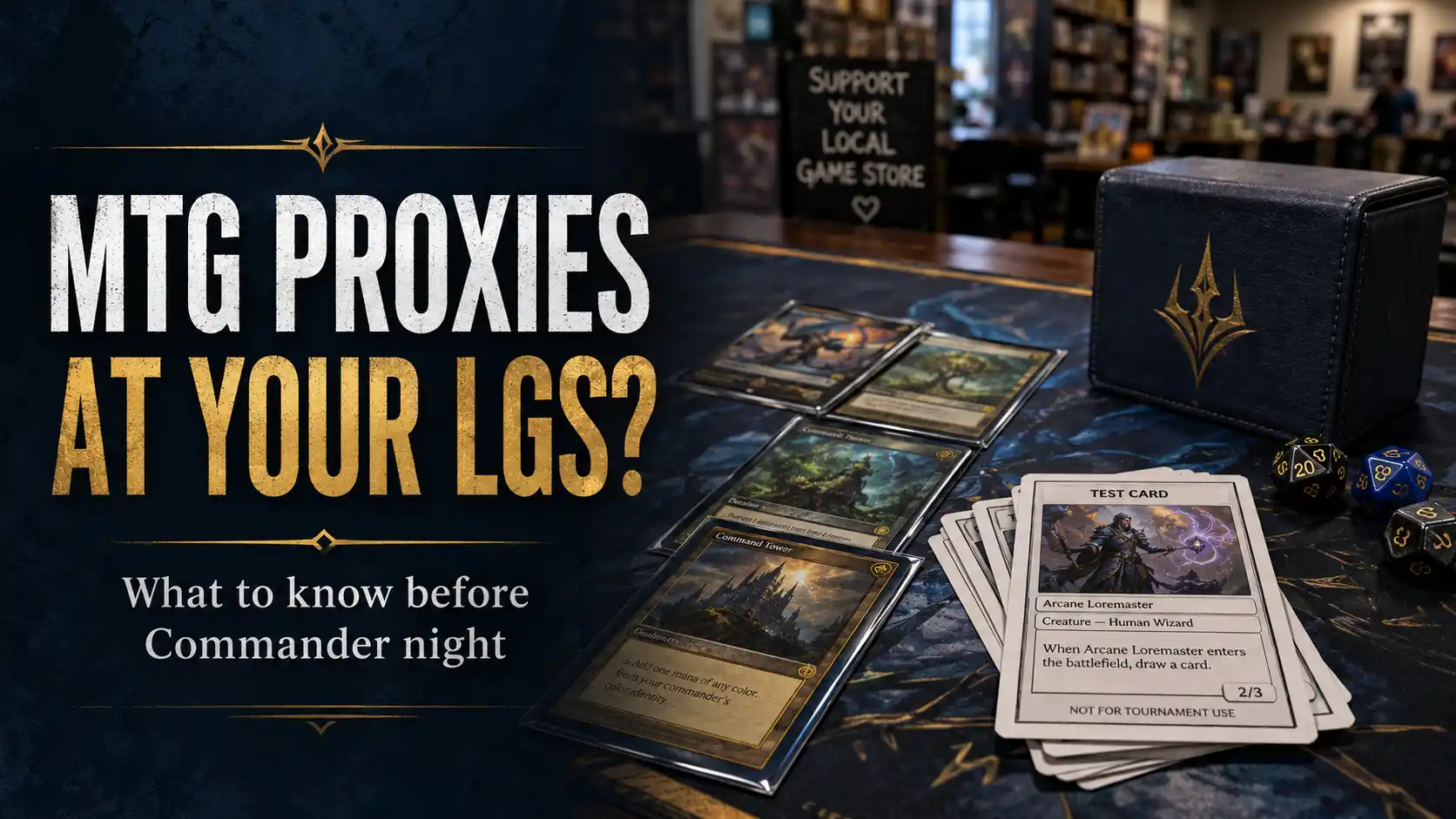
You can use MTG proxies at some local game stores, but only when the store and the players allow it. Do not assume proxies are fine just because the event is casual, Commander-focused, or held on a weeknight with snacks and folding chairs.
The simple rule is this: sanctioned events require authentic Magic cards, while unsanctioned casual play depends on the store policy and the people at your table. If you want the least awkward version of the answer, ask before you shuffle.
The Real Answer: Sometimes, But Ask First
Can you use MTG proxies at a local game store? Sometimes, yes.
Can you use them in every event at every local game store? No.
That is the part that causes confusion. Players hear “Commander is casual” and assume that means “anything my pod agrees to is fine.” In a kitchen-table game, that is mostly true. At a local game store, there is another layer: the store.
A local game store might run different kinds of Magic nights:
- Official sanctioned events
- Casual Commander nights
- Store-run leagues
- Prize-supported Commander pods
- Open play
- Cube drafts
- Learn-to-play nights
- Private playgroups using the store tables
Those are not all the same thing.
A proxy-friendly kitchen-table rule does not automatically carry into a store event. The LGS may have its own policy, and the store may be trying to stay clear of any trouble around sanctioned play, prize support, customer expectations, and counterfeit confusion. Most store owners would rather sell sleeves and keep the peace than referee a courtroom debate about your printed Gaea’s Cradle.
Fair enough.
Sanctioned Events Are Different
The biggest dividing line is sanctioned versus unsanctioned.
In sanctioned Magic events, players are expected to use authentic Magic cards. Wizards of the Coast has been clear that official sanctioned play is not the place for player-made proxies. The narrow exception is judge-issued proxies for specific tournament situations, such as a card becoming damaged during an event.
That means you should not bring proxy cards to:
- Sanctioned Friday Night Magic
- Store Championships
- Prereleases
- RCQs
- Officially reported Commander events
- Any event using official tournament rules
- Any prize event where the store has said proxies are not allowed
This is where people get tripped up.
They see “Commander night” and assume it is loose casual play. But if the store is reporting it, attaching official promos, running prize support, or treating it as an official event, proxies may be off the table.
The safe question is not “Is this Commander?”
The safe question is:
“Is this event sanctioned, and are proxies allowed?”
That one sentence saves everyone time.
Casual Store Play Is Up to the Store
Outside sanctioned events, things get more flexible.
A store may allow proxies for casual Commander tables, playtesting, cube drafts, or open play. Another store may ban them completely. Another might allow a small number, but only if they are readable and not used as counterfeits. Another may say, “We do not care what you do at the back table as long as nobody complains.”
Very official. Very human.
For casual local game store play, proxy rules usually fall into one of these buckets:
- No proxies allowed in store
- Proxies allowed only for casual open play
- Proxies allowed if you own the real card
- Proxies allowed up to a set number
- Proxies allowed except for high-power cards
- Proxies allowed only with pod approval
- Proxies allowed for testing, but not prize events
- Proxies allowed for cube or closed playgroups
None of these policies is universal.
That is why the practical answer to can you use MTG proxies at a local game store is always: check the store’s policy first, then check with the table.
Why Stores Care About Proxies
Some players take proxy restrictions personally. Usually, that is not necessary.
A store might restrict proxies for several reasons.
They Want Clear Event Rules
Stores need simple rules that staff can explain quickly.
“Official events use official cards” is easy. “You can use proxies, but only some proxies, unless your table agrees, unless there is prize support, unless the card is too expensive, unless Carl is working because Carl has opinions” is less easy.
Also, nobody wants Carl making policy from behind the register. Carl has enough going on.
They Want to Avoid Counterfeit Confusion
A proxy is not the same as a counterfeit.
A healthy proxy is a clear stand-in for casual use. It should not be sold as real. It should not be used to trick anyone. It should not be designed to fool a buyer, a judge, or a store employee.
Stores are right to be cautious here. They handle trades, singles, collections, and new players. If a proxy policy creates confusion around what is real and what is not, the store may simply decide the cleanest policy is no proxies.
They Want to Protect Prize Events
Prize events need tighter expectations.
If an event has entry fees and prizes, players tend to care more about deck legality. Suddenly, the proxy conversation becomes less “I want to test a deck” and more “I paid to be here and now I am facing a fully proxied optimized list.”
Even if everyone is friendly, prize support changes the mood.
They Want Players to Buy Cards
This is the uncomfortable one, but it is real.
Local game stores sell sealed product, singles, accessories, snacks, and table space. They are not running a public gaming room out of pure abstract love for your Atraxa deck. Well, maybe a little. But rent exists.
Some stores are proxy-friendly because they know proxies keep people engaged in the hobby. Others are cautious because they see proxies as competing with singles sales. Both views exist.
The Best Way to Ask a Store About Proxies
Do not make it weird.
Do not walk in and announce a manifesto about accessibility, capitalism, and the Reserved List while holding a deck box like evidence.
Just ask.
Try this:
“Hey, I’m coming for Commander night. Do you allow proxy cards for casual games, or only authentic cards?”
If they say yes, follow up with:
“Is there a limit, or is it up to the pod?”
If they say no, accept it.
That does not mean the store hates fun. It means the store made a policy. You can still play with original cards there and use proxies at home, with friends, in testing groups, or in other proxy-friendly spaces.
If the answer is unclear, ask whether the event is sanctioned. That is the key detail.
Ask the Table Too
A store can allow proxies and your table can still care.
Commander is a social format. The pregame conversation matters. If your deck has proxies, mention them before the game begins.
You do not need a dramatic speech. Just say:
“This deck has about ten proxies. Mostly lands and a couple cards I am testing. It is mid-power, not cEDH.”
That is perfect.
The table now knows:
- You are using proxies
- Roughly how many
- What kind of cards they are
- What power level to expect
- That you are not trying to sneak anything in
The problem is almost never a proxy land by itself. The problem is surprise. Surprise Mana Crypt has ended more friendships than it should have. Not officially measured, but spiritually accurate.
What Kind of Proxies Are Usually More Accepted?
Some proxies are easier for casual tables to accept than others.
Readable Proxies
The card should be easy to identify from across the table. Name, mana cost, card type, and rules text should be clear.
If everyone has to pick up your card every turn to remember what it does, the proxy is not helping.
Test Cards
Most players understand testing.
If you are trying a new deck before buying singles, proxies make sense. Commander decks can get expensive fast, especially once you start upgrading mana bases and adding format staples.
Duplicate Copies of Cards You Own
Many groups are fine with this.
If you own one real Rhystic Study but do not want to move it between four decks, a proxy copy can be practical. The table may still care about power level, but the idea itself is easy to understand.
Expensive Lands
Lands are often the least dramatic proxy category.
Fetch lands, shock lands, triomes, and utility lands can make a deck function without necessarily turning it into a nightmare. The deck casts spells. The game improves. Everyone gets to do the thing they came to do.
Cube and Closed Playgroup Proxies
If the entire environment is proxy-based, there is usually less tension.
A proxy cube, test gauntlet, or closed Commander league can set its own rules in advance. Nobody sits down confused.
What Kind of Proxies Cause More Pushback?
Some proxies are legal in Commander, but socially loud. They change how the table reads your deck.
Expect more questions if you proxy cards like:
- Mana Crypt
- Jeweled Lotus
- Fierce Guardianship
- Deflecting Swat
- Vampiric Tutor
- Demonic Tutor
- Rhystic Study
- Mystic Remora
- The One Ring
- Gaea’s Cradle
- Original dual lands
- Dockside-style burst mana
- Fast combo pieces
The problem is not that these cards can never be proxied. The problem is that they tell the table something.
If your deck is full of high-efficiency staples, free spells, fast mana, and tutors, it probably belongs at a stronger table. That may be fine. Just do not present it as casual because it has a silly commander and one card with a goat in the art.
Commander players have been fooled before. They have scars.
Use Commander Brackets as a Conversation Tool
Wizards has introduced Commander Brackets as an optional way to talk about the kind of game people want. You do not need to treat brackets like law, but they are useful for proxy conversations.
A proxy deck can be low-power, mid-power, optimized, or cEDH. The proxy status does not decide the bracket. The card choices do.
A fully proxied goofy tribal deck might be casual.
A deck with only three proxies might be terrifying if those three cards are fast mana, a tutor, and a combo engine.
When you sit down at a local game store, describe the deck in play terms:
- “This is a Bracket 2 style casual deck. Some proxies, mostly lands.”
- “This is upgraded but not optimized. It has a few strong cards, no fast combo.”
- “This is high-power and has a lot of proxy staples.”
- “This is cEDH testing. Probably not right for a casual table.”
That is much better than “it has proxies” or “it does not have proxies.”
Power level is the real issue. Proxies just make the issue visible.
What If the Store Says “Only If You Own the Card”?
Some stores and playgroups allow proxies only when you own the real card.
This is a common compromise.
It lets players protect expensive originals and avoid moving staples between decks, while still keeping a connection to card ownership. Not everyone loves this rule, but it is easy to understand.
If your store uses this policy, be ready to follow it. That might mean bringing a binder, having a decklist, or simply being trusted by your group. Each store handles it differently.
If you do not own the card, do not argue that the internet said proxies are good. The internet says a lot of things. Some of them involve eating cereal with orange juice. We do not build policy around that.
What If Your LGS Bans Proxies Entirely?
Then do not use proxies there.
That is the clean answer.
You can still use proxy cards in other settings:
- Home Commander nights
- Private playgroups
- Cube drafts
- Deck testing sessions
- Webcam games with proxy-friendly groups
- Collection display
- Binder projects
- Custom casual formats
A local game store has to manage more than your deck. It has staff, events, younger players, collectors, official programs, trade binders, and community expectations.
You can disagree with the policy and still respect it.
That is not very spicy, but it keeps you welcome in the room.
A Simple LGS Proxy Checklist
Before bringing MTG proxies to a local game store, ask yourself:
- Is the event sanctioned?
- Is there prize support?
- Does the store allow proxies?
- Does the pod allow proxies?
- Are the proxies readable?
- Are they clearly not authentic cards?
- Is the deck’s power level honest?
- Am I using proxies to test, protect, or balance the deck?
- Would I be comfortable explaining every proxy before the game?
If the answer to those is yes, you are probably in good shape.
If the answer is “I hope nobody notices,” stop. That is the bad version.
How Nerdventure Fits This Use Case
Nerdventure proxy cards are best understood as casual-use cards for players, collectors, cube builders, and deck testers. They are not official tournament cards, and they should not be used to misrepresent anything as an authentic original.
That matters.
The healthy use case is simple:
- Build a casual Commander deck
- Test cards before buying originals
- Make a cube easier to draft
- Protect valuable originals from wear
- Create a cleaner-looking playtest deck
- Fill a binder or display page
- Build a custom casual project
The unhealthy use case is also simple:
- Sneak proxies into events that do not allow them
- Pass proxies off as real cards
- Trade or sell them as authentic originals
- Ignore store rules
- Misrepresent deck power level
Those are not the same thing. A good proxy policy depends on that distinction.
So, Can You Use MTG Proxies at a Local Game Store?
Yes, you can use MTG proxies at a local game store when the event is unsanctioned, the store allows them, and your table is comfortable with them.
No, you should not use them in sanctioned events that require authentic Magic cards.
And maybe, you can use them in casual store play if the shop has a proxy-friendly policy.
That is the real answer. Not as clean as “yes” or “no,” but much more useful.
Ask the store. Ask the pod. Be clear about power level. Use readable cards. Do not pretend proxies are real. Do not bring a fully optimized proxy deck to a precon table and act surprised when people look at you like you brought a chainsaw to a pillow fight.
Proxies can make Magic more affordable, more creative, and more fun.
They just work best when everyone knows what game they are playing.
SEO Pack
Title Options:
Can You Use MTG Proxies at a Local Game Store?
Are MTG Proxies Allowed at Commander Night?
MTG Proxies at an LGS: What to Ask Before You Play
Focus Keyphrase:
can you use MTG proxies at a local game store
SEO Title:
Can You Use MTG Proxies at a Local Game Store?
Meta Description:
Can you use MTG proxies at a local game store? Learn when proxies are allowed, when they are not, and how to ask before Commander night.
Slug:
can-you-use-mtg-proxies-local-game-store
Excerpt:
Can you use MTG proxies at a local game store? This guide explains sanctioned events, casual Commander nights, store rules, and proxy etiquette.
SEO Tags:
MTG proxies, Commander night, local game, proxy cards, casual Commander, store policy, deck testing
References and Citations
Wizards of the Coast: On Proxies, Policy, and Communication
Wizards of the Coast: Commander Format
Wizards of the Coast: Introducing Commander Brackets Beta
Wizards of the Coast: Commander Brackets Beta Update, October 21, 2025
Nerdventure: MTG Proxy Cards
Nerdventure: Proxy Use Policy
Nerdventure: Our Brand